Monday, February 22, 2010

The Permaculture Design Certificate

The Permaculture Design Certificate (PDC)
by Jesse Lemieux

What is needed to design a sustainable human society full of abundance and security for all living systems? Information, empowerment and ethics.

The Permaculture Design Certificate (PDC) teaches students how to use information, resources and ethics to meet local needs on a limited land base.

There are no "bad guys" and nothing is inherently evil. It is the designs of the systems we use that are the problem. A large machine can be use to bring down a forest, or it can be used to repair damage and degraded landscapes. In the same way, I can either use a hammer as weapon, or to build a house for a friend. The difference in outcome is one of intention and design.

The fact is that we are working with a system that was never designed to provide a sustainable or secure place for life on this planet. The system we are working with was designed to concentrate wealth, resources and power into the hands of a few. This system produces elite classes, sickness and environmental degradation.

The justification for such destructive ways was one of service to the larger whole. In other words, we tell ourselves that while the present way of doing things does not provide all people in all places with a secure livelihood, it can maximize happiness for a maximum number of people.

A great many good things have come out of this system, like this computer I
type with. But it is obvious that the time for change has come. The planet is raising alarm bells. Fancy technological adaptations may give us some extra time, but if we are concerned with the long term survival of the human species, then we had better start evolving and designing our systems using more sustainable models.

At the very core of our problems are the assumptions we make regarding human nature. We design and build our systems with the underlying belief that human nature is dominated by greed. As a result, we see human interaction with other humans and the environment as brutal struggle, domination and conquest.

Nothing could be further from the truth. What makes us human is not how savagely we can treat each other. What makes us human is our large brain, and our capacity for abstract thinking and creative problem solving. Human nature is one of choice. We as a species and as individuals are capable of just as much positive action as we are negative. In my experience, 99 out of 100 people have good intentions and want to do the right thing.

So what is the issue?
The issue is design. The Permaculture Design Certificate teaches how we can utilize today's tools and technology to shape a more sustainable and equitable world for all species. Permaculture is more than just planting a garden. It is a sustainable design approach that is applicable to all human activities. An organic garden is one element in a total design. Permaculture is about where we place the garden in relation to the house, site topography, climate, water run off, capabilities of the users, where money comes from to finance it ...ect. Using a designed approach place the organic garden in space, time and form so as to gain the highest output for lowest input.

The PDC is an intensive 72-hour study in all things sustainable. It uses the 14-chapter text book "Permaculture, A Designers Manual" as its reference and works through the following topics:Introduction to Permaculture
Concepts and Themes in Design
Methods of Design
Pattern Unders
tanding
Climatic Factors
Trees and their Energy Transactions
Water
Soils
Earthworks and Earth Resources
The Humid Tropics
Dryland Strategies
Humid Cool to Cold Climates

Aquaculture
The Strategies of an Alternative Global Nation

As you can see from the above list, permaculture covers all aspects of human life. It is grounded in practical real world design and extends into the complex realm of sustainable social design. It extends further into the invisible design of organizing energy exchange between people and communities.
The PDC empowers, informs and trains people to be effective designers and agents of active change in their homes and communities. The PDC endeavors to teach teachers, in order to spread and localize this important information. Following this strategy, permaculture has spread rapidly to all corners of the globe without any form of centralized administration or governing body. As a result, there are many collectives and collaborations between different permaculture teachers and institutes, but all operate as independent entities. The permaculture community is unified by the common ethic of earth care, people care and return of surplus.


Permaculture does not ignore the massive challenges we face today. We maintain a healthy of the challenges and difficulties of the modern world. We choose to focus our time and energy on a positive and active approach. Rather than spending a Saturday at a rally protesting something I don't want, I would rather spend the day with a group of friends and strangers installing a food garden in the community. In this way we actively change the world one garden at a time.


Many of my students quickly move on to be involved in all levels of change from local to global some as private business others for NGOs.

Adrian Buckley of Calgary took his PDC in August 2009. This course was taught by Pacific Permaculture on behalf of Ravis Sustainable. Since that time, Adrian has started a small permaculture business called Big Sky Permaculture, which recently hosted its first Introduction to Permaculture Workshop this past January. He is a great example of how quickly a PDC can change the direction of one's life.

Angela Gentili of Toronto attended the Pacific Permaculture part time PDC in Vancouver in the spring of 2009. She has recently co-founded a non-profit community organization in Toronto known as Reseed.ca. They are involved in all kinds of great community agriculture initiatives using permaculture in their work.


Aaron Elton of Vancouver is yet another student of ours, from the PDC course that Pacific Permaculture hosted last summer on Denman Island. Aaron has initiated a permaculture aid project known as Our Mother Earth Villages, which will be operating in Uganda and teaching its first PDC to local and international students in late 2010.

There is no doubt in my mind that a full education in permaculture design is a positive experience. It's an investment that anybody can make regardless of profession, background or age.


Pacific Permaculture is offering a second annual installment of a Vancouver part time course starting April 3. If you are interested in the 2-week intensive format, we are hosting a course on Denman Island July 4-17, and teaching another in Saskatoon in the middle of August.

Please visit our website www.pacificpermaculture.ca for more info.

We are not the only group that is offering the PDC in western Canada. Below is a list of other groups and organizations that regularly teach the 72-hour PDC.

Ravis Sustainable (Calgary) http://bit.ly/coY5tM

Urban Farmer (Edmonton) http://bit.ly/bviP9U

OUR Ecovillage (Shanigan Lake) http://bit.ly/9sITrx

Blue Raven Permaculture (Salt Spring Island)
Kootaneey Permaculture (Winlaw BC) http://bit.ly/abXHUS

The term "permaculture" was coined by Bill Mollison and gifted to the college of graduates of the Permaculture Design Certificate. As teachers, we all agree to adhere to the design curriculum as laid out in the 14 chapters of the permaculture designer's manual. Only graduates of this curriculum may refer to themselves as permaculture designers and permaculture teachers. However, anyone engaging in activities which relate the ethics and principles of permaculture may refer to their work as permaculture.


Before attending a PDC be sure that the whole 14 chapter curriculum from "Permaculture A Designers Manual" is being presented. The course must cover all the material over 72 hours. and should not have extra material included. Good luck and we will see you out there.

Saturday, November 21, 2009

Permaculture: Important Positive Change

I am excited to be stretching into some relatively unknown areas of my ability, by taking on the role of a bi-weekly columnist for a new free paper in Vancouver known as "The Agora." Look for it the next time you are out and about. Below is my submission for this weeks issue. As each article is produced I will continue to post here on Pursuing Permaculture. Since Tanya and I started this blogspot two years ago neither of us have been able to give it the attention it deserves, now that we are moving off of the orchard, we will be able to engage our permaculture activities full time and that includes this space. Please stay in touch and let us know how we are doing, share with you friends.

Regards Jesse

Permaculture: Important Positive Change

By Jesse Lemieux

Like most important activities on the planet, permaculture has very little recognition in the main stream media. Consequently, only a few people know what permaculture is and the role it is playing in the dramatically changing physical, political, cultural and social climates. Even fewer people understand or are aware of what impact permaculture is having locally. In actual fact, permaculture practitioners are active, and determined to be a positive and functioning part of the design overhaul that global society is presently undergoing.

I have been involved with the global permaculture community for a little longer than three years now. In late 2006 I went on a three month trip to Australia seeking an education in permaculture design. I really didn’t know what I was getting into. After my design class, for the first time in my life I felt empowered to make a difference on what ever scale I could. Rather than a world of scarcity I began seeing endless opportunities and abundance amongst all the chaos. I arrived home and immediately started to share with any one who would listen. In late 2007, my wife Tanya and I left Canada to build our practical permaculture experience Down-Under. Our journey lead all over eastern Australia to the Middle East and finally landed us on Denman Island, BC in September of 2008. We have settled here, managing an apple orchard and running our young permaculture education and consultancy, Pacific Permaculture. In this time we have encountered all edges of the permaculture movement, from the global to the local.

In the Beginning there was Bill Mollison, a disgruntled and brilliant academic. In the early 80‘s and the twilight of his life and career, he composed the Permaculture Design Certificate (PDC) curriculum and travelled the world teaching to all who wanted change. He knew that the only way to catalyze truly positive change was to teach more teachers. The message he taught was “earth care, people care and return of surplus.” During its first two decades permaculture was taken up by little more than a fringe few in the developed world and a handful of aid projects in less fortunate places. More recently, as the design system produces more and more credible results, permaculture has seen an explosion in popularity and growth. In Australia, Mollison’s country of origin, permaculture has entered the curriculum at all levels of institutional education and still maintains its strongest presence in the grassroots. Permaculture can not be brought under copy write and controlled by a central authority, as the term “permaculture” was gifted to all graduates of the (PDC), a clever strategic play by Mollison. This open source character has kept permaculture widely accessible and truly democratic. In this merit-based teaching system, good teachers have students and poor teachers don’t. Credibility can only be built upon ones results in the field, not locked up behind the walls of a large organization. Mollison’s efforts produced the first generation of permaculture educators and designers. That generation has done its job well, as it is not uncommon to come across a fifth or sixth generation PDC student. In 2006 I was lucky enough to have been trained by Mollison himself.

The average permaculturalist is just that: average. Permaculture is such a straightforward and practical approach to designing human habitat and settlement that anybody who is interested in positive action can easily understand the basic principles. The inherent simplicity and elegance of permaculture design, the common sense solutions and the lack of glamour makes permaculture the effective agent of change it has become. Boil down the movement and most permaculturalists, if any, have little interest in making a name for themselves. They measure success less by fame and reputation and more by the results they get in the field.

Permaculture designers relish a challenge, pitting their design skills against the most difficult of climates and landscapes. As a result, permaculture is most well known for its application in aid projects and grassroots development activities in the world’s most impoverished regions. The most well known example to date is Geoff Lawton’s hyper-arid design installation in the Dead Sea Valley of Jordan. A student of Mollison’s, Lawton used elegant earth shaping design to fully utilize all available rain water. With the help of hardy pioneering tree species Lawton transformed the dead and salted desert land into a permanent, self-watering and self-sustaining forestry and crop agricultural system. This seminal work has been well documented in video. Check out the following two websites: http://www.youtube.com/watch?v=LJ8pjOG4pXI&feature=related and http://permaculture.org.au/2009/11/17/greening-the-desert-ii-video-greening-the-middle-east/, for a full synopsis.

This important work by Lawton has inspired thousands globally, myself included, to take up training in permaculture design and get active in their communities. An excellent local example is Permaculture Vancouver. Permaculture Vancouver is a local group that meets once per month to share experience and inspiration in permaculture design. Only 7 months old and 165 members strong, many have taken a permaculture design certificate but most haven’t. This group is fully open to all levels of understanding and interest. They are moving fast and have already been seen with a booth at the PNE and doing urban permaculture makeovers in yards throughout Vancouver. If you want to get hands on experience and learn more about permaculture I encourage you to head out to one of the monthly meetings. You can contact this group at: http://www.meetup.com/The-Vancouver-Permaculture-Meetup-Group/.

Monolithic governments and universities, and those entrenched in such institutions, will still be talking about how to manipulate “sustainable consumer” behavior, long after permaculture teachers have empowered and educated society in the art and design of a local production culture. I do not understate the complexity and scale of the problems we face, some days it can feel daunting. The potential solutions can seem just as overwhelming. I do concede that the change required on a global scale is truly staggering. However that change is massive only for the the shear number of small scale and local initiatives required. I do not faithfully and blindly believe that “everything little thing is gona be alright.” I do, however, know that if we choose to, each and every one of us can initiate and sustain significant and positive change. The first step is to stop complaining about what we don’t want, and ask the question: What do we want? From that all important question we can take steps towards a different world. This is exactly what permaculture designers and educators are doing. They both empower with information and implement appropriate small scale solutions wherever they go.

Thursday, September 24, 2009

What has happened to Tanya and Jesse?

So here we are...over five months and not a peep on this blog from either Tanya or my self.
What have we been up to?

In short...
Teaching.
Pacific Permaculture has wrapped up a most successful first season, as a permaculture education service. Our first season of teaching services have been immediately responsible for unleashing 60 new permaculture designers into the world. I doubt a virus would be so luck as to get as many subsequent infections from one host.

Here is hoping that we have "terminally infected" some of those bright students of ours with the permaculture bug. We are now re-grouping and planning for the 2010 season. It is going to be a big one with lots of exciting twist and turns.

Before we get into that I would like to do a quick recap on the past five months...

Permaculture Design Certificate number one Part time course, Vancouver BC, March 2009
Our first full length PDC. thank you to the 15 brave souls who attend. Your support, enthusiasm and continued good work in Vancouver, Permaculture Vancouver, is truly humbling keep it up. You make a "permaculture father and mother" proud.


I really enjoyed teaching this group of people. I learned more about permaculture than I ever though possible. My only hope is that they got as much from this experience as I did. We will surely be running another course like this in the not so distant future. The part time format is a great way to make permaculture accessible to urban dweller, whom does not have two weeks to spare for a residential course out in the boonies.

This course finished the last weekend of April and we used our time to prep for...

Permaculture Design Certificate number two, Full time Residential Course, Denman Island BC, July 2009

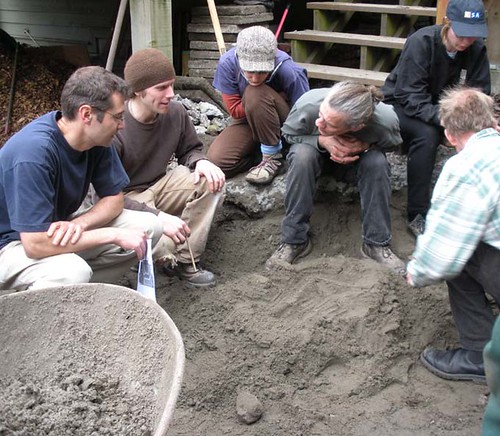
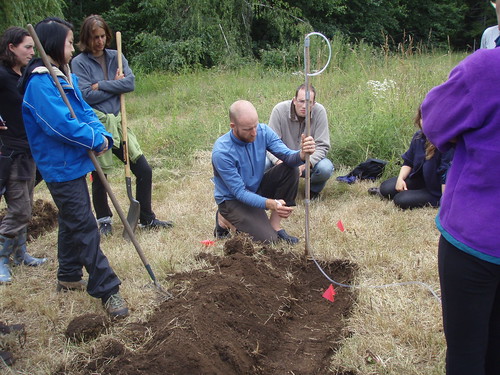
For two weeks Tanya and I hosted 24 people including ourselves. The end result being...19 new permaculturalists out into the world. While the part-time format is a great way to run a PDC, as it allows better access for time strapped people in cities, there are certain aspects of the 2 week residential format that can't be beat. The immersion of it all as well as access to out door labs, as shown above, really help to drive key concepts home. More and more we are finding that direct experience and reflection on lessons learned are a crucial part of the active learning process.

Permaculture Design Certificate number three, Full time Residential Course, Gull Lake Alberta, August 2009

Look out Oil Sands, here comes the Alberta permaculture movement. Rob and Michelle, of Ravis Sustainable, put together a fantastic PDC with field trips and outdoor hands projects to spare. I got it easy with this course, as all I had to do was teach and drink coffee. Since this course, local permaculture community groups are starting to pop up all over the prairies. I just can't get enough of Alberta and we are going to kick off our 2010 season with several Intro to Permaculture courses this coming January.

Stay tuned for more.
I promise!

Thursday, April 9, 2009

Compost, Snakes and Dams

Spring has sprung and we are busy as the bees. Here on Denman there is plenty to do on the farm; and course and consultancy have us in Vancouver on a weekly basis.
It's compost mania and we are having a lot of fun putting together different composts with different combinations of material. First, on Denman we had our lovely guest Jill from Green Temple Design helped us gather seaweed, leaves and other compostable materials and put it together. It was heaps of hard work but we gathered enough to make a go of it. We mixed the compost by measuring in big buckets ratios of Carbon and Nitrogen. We then used a bit of blood and bone left over from the garden construction and of course the magic ingredient of urine. On top of all that we put some comfrey tea that we've been brewing for the last few months and it only added to the already powerful odor. We decided to put in a chimney because we were sure that it was going to get very hot. We've used this method before, it keeps the pile from getting too hot and it worked well by allowing some of the heat to escape. The next day Jill and Jesse headed back to Vancouver to make more compost and I prepared seedlings and worked on the orchard. In Vancouver the permaculture design group put together their own compost pile using different materials not the least of them being several dead pigeons. The loft in the barn where Jesse gathered some hay had dead pigeons and owls and well... why not? The pile was made in our friend Jared's back yard in east Vancouver. I was not there for the initial turning but didn't have to be to know that this was one spicy hot concoction. When given some time and flipping around by Jared this pile evened out nicely. No more pigeon evident.
Back on the Island things are doing very well. The weather is beautiful, although, it may be leaving us soon. That is fine with us as some very
vigorous planting has gone on and we would love to have it rain now. Only one of our gardens was ready and organized for a planting blitz but we took to it as soon as we had a chance. I went a little crazy and got a lot of my seeds started many weeks ago so it was definitely time to set some out. While planting we discovered a small colony of snakes living in our garden. At first I was concerned that there were so many but then I found out they eat slugs. I had not thought of snakes when it came to controlling those who wish to eat my greens. So we took a picture of one of the more friendly snakes and he/or she was very compliant and very beautiful. Off to the town of Mission now to put in preliminary markers for some dam and swale systems for two lovely part-time homesteaders. Maybe we'll do some composting there as well. The well turned compost pile will be our cairn. Rather than leaving behind a pile of ruble to mark our place we will leave a piled humus cairn.

Sunday, March 15, 2009

Permaculture in the fast lane

In the past three months, every time I have tried to sit in front of this machine and tell a tale I find myself pulled away by other things. In order to catch up I will be light on words, and heavy on pictures. Do not mistake a lack of words, for little to say. More likely I have too much to say, I just wish to get up to speed and on to new things, as we have a lot happening this coming season.In January we taught two Introduction to Permaculture workshops. One was held in Calgary and the other in Canmore. We had a really great time and met some wonderful individuals, doing amazing things for the world. We made some new friends, Rob and Michelle Avis, and had a great exchange of information and ideas in regards to permaculture in BC and Alberta. We took the opportunity to visit some family and friends, while in Alberta, and were able to get to some pretty spots. When we arrived it was around -20 degrees in Calgary and two days later we went to Edmonton where it was -39 degrees. I have never been so cold before, but there is a special kind of beauty in a landscape so stark.
Permaculture is going wild and spreading across the province of Alberta at a blistering pace. With the energetic and dedicated contributions of Rob and Michelle, permaculture is gaining ground in the prairies. If you are interested in more courses being held there this summer check out Ravis Sustainable. While in Alberta, we had the honor of hosting our first children in an Intro class. Despite our hesitations, these to young eco-warriors exceeded expectations and added immensely to the experience.
We returned from Alberta at the beginning of February. Once back on the coast Jesse gave a series of talks and seminars in and around Vancouver. They all went very well and, while Jesse was a sharing our experiences with others, I was back on the farm pruning the apple orchard. In order to stay where we are and do what we do there is a certain amount of work that has to be done, on the farm. In between the work on the farm we surveyed our garden site to render a design and plan for the coming season.
At the end of February it was off to Kelowna, for the Building Sustainable Communities Conference put on by the Fresh Outlook Foundation. We were excited about this conference, as it was the very first invitation we received when our web site was launched in May of 2008. It was a great opportunity to share permaculture and our experience with members of the private, academic, and government sectors. The response was fantastic.
A day after the conference we were back on the coast to teach an Introduction to Permaculture workshop in Vancouver. With a full house and a lovely group of people it went very. Several of our students from that course have since enrolled in full length PDC course with us, it gives us a great sense of accomplishment to have such positive feed back. Hopefully we can assist some of these active and inspired people get on their feet, as teachers in the coming months. It is only through empowering local teachers and designers that we are going to turn the environmental boat around.
At the beginning of March we are back on Denman Island. For the next few days we worked hard to get our garden prepared for the coming growing season. We continued on from the surveying and planning phase into implementation. It took about one day of hard work to get most of the garden in place. This is the before picture, as we are trying to fix a gutter for rain water to flow into the garden off the roof.
We made on contour level pathways and used the rock that we pulled out of the site to help prop up three beds. We cover cropped and planted some mint and strawberry, both great crawling perennials, to help keep back the grass and weeds along the edges. This is to be an annual greens garden with a strong edge of perennials to help fill the space nature would otherwise fill for us. Below is a picture of the end product shaped, seeded and mulched.
I started my seedling early so that I can have nice strong plants to put in the garden this year. I was also a bit too excited and hopefully I am not too far ahead of the game. Gardening in a more northern area is going to be interesting but it is going very well so far.

And in our spare time...... well there is not much of it around but we do like to enjoy the island now and again. A few weeks ago we went out and dug a few dozen clams for Manhattan clam chowder. Even when we are playing we are working, we always try to come home with wild harvest food from our days off!!!
So here we are, garden planted, rain falling, seedlings growing, part time PDC starting on March 21st and now we have a crab trap out in Baynes Sound filling with food as I write. Busy, busy, busy and I haven't even mentioned what is on the horizon...another aid project?

Thursday, December 11, 2008

Permaculture....more than organic gardening!!! Part 2

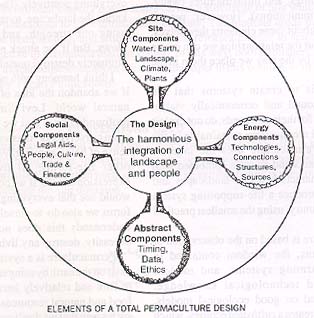
Energy Components
Technologies, Connection, Structures, Sources

When designing and establishing systems we must prioritize our investments first in structures and technologies that create energy, second that save energy and last that consume energy. It is inevitable that we will spend energy to initially establish our habitat. This is not a problem, so long as the designed habitat produces more energy over its lifetime than was initially spent. All systems should provide their own energy needs and remove themselves as much as possible from a dependence on distant sources. “When the needs of a system are not met from within, we pay the price in energy and pollution.” (Mollison)

When designing to the site-specific components the first priority is water, as water is an energy that can be put to great use. Higher elevation rainwater storage (earth dams and tanks) should be designed into a landscape whenever possible. This is done to provide gravity fed water for crops houses and other uses at lower elevations. Swales are always planted to trees. They are tree-growing systems. The trees use water harvested by swales to turn the suns energy into wood and foods, like nuts and fruit. The wood can be used to build and maintain structures, provide fiber and heat, for solar efficient homes, in high efficiency stoves. By first investing in the water structures we have created numerous energy storage in our settlement.

Social Components
People, Culture, Trade, Finance

Cooperation not competition is the key. Presently my wife and I live on an apple orchard, together we contribute 40-50hr/week of our time and energy to the orchard. We are not the owners. In exchange for our efforts, we get a roof over our heads, clean and healthful food from the garden, access to land for our own food production and a good community. Assessing this arrangement from a purely financial perspective would neglect all other levels of wealth that we obtain from the relationship. Further more we can be assured that a significant proportion of our time and energy will stay within the systems on the farm. If we were to have regular jobs, within the formalized economic system of distant capital and finance, most of our time and energy would inevitably by exported out of the local environment and economy. By working to keep our time and energy cycling in the local economy through a non formalized system of exchange: trade barter and cooperation, we work to ensure our efforts go towards building the health and security of our community. We reduce our need for monetary gain, as our basic needs of clean food, clean water, clean shelter and healthy community are produced through our basic day-to-day interactions.

Abstract Components
Timing, information, ethics

Without an ethic or belief structure and actions in relation to survival on our planet, permaculture has no starting point. The basic permaculture ethic is as follows:
Care of the earth
Care of People
Return of Surplus to the above two ends (can also be understood as setting limits to growth)
With the ethic as our sounding board, we can use all available information to design healthy communities and provide for those communities without degrading local and distant ecology. In order to spread good design we must spread information to where it is needed and assist others who are trying to learn. As much as we need to combat against a lack of information, we should guard against an over abundance of data. “Information is only a resource if acted upon.” (Mollison) At some point we need to take a step forward and get our hands dirty.

It is only through the functioning connections between components that a complete whole system design can be achieved. The designed systems must maintain and build the health of the local environment and work for its occupants, not distant sources of capital, if it is to be sustainable. This can only be achieved by analyzing the needs and products of various components and placing those components where they supply each others needs and best utilize the inherent energy flows of the landscape and climate. Organic gardening is vital to any sound design, as we all have a right to clean food, but it must be placed appropriately within the context of the whole systems design that is known as permaculture.

Saturday, November 22, 2008

Permaculture....more than organic gardening!!! Part 1


It is often the case that permaculture is mistaken for being just another form of organic gardening. This description is seriously lacking when considering permaculture and the influence it is having, and can have, in our rapidly changing world. “Permaculture is a design system for the harmonious integration of landscape and human habitat” (Mollison) An organic garden is only one element, an important element, but only one in an infinite number of different elements that might make up appropriately designed human systems. At the heart of good design are the functional relationships between elements and how they support each other. Permaculture is not about finding new and complicated high tech ways to support our present culture of waste and "protracted thoughtless labor". It is about integrating: site, energy, social, and abstract components to provide for human needs by creating and recycling resources and energy without degrading local and distant environments.
In the next few months we will be developing our own water, food, and animal systems here on Denman Island. Our system will be designed to provide for more than our own personal needs, as we are offering permaculture design courses and bringing in many people. As we go through the design process we will write about our efforts to implement permaculture design. Win , lose or draw we will reveal how easy or difficult it is to design a 1/4 acre lot starting from our front door. Through the process we will demonstrate how permaculture design is so much more than organic gardening.
Permaculture is not a hippie movement or a religion. Permaculture is a practical ethical way to move forward in a world of uncertain futures. The more we take responsibility for the cycle of resources around us, the richer and more abundant day to day life will be. The more connected we become to our community the more it will be there for us in the future.
http://www2.kenyon.edu/projects/Permaculture/ryan.jpg

Site Components
Water, earth, landscape, climate, plants

An appropriate design first considers local conditions and then harmonizes developed systems with those conditions to achieve that highest level of energy conservation possible.

Water, Access, Structures

This is the priority sequence of permaculture site design. By first designing water infrastructure (swales, dams, irrigation lines, diversion drains, irrigation ditches…) to harvest rainwater and store it passively throughout the landscape, we insure the fertility of the land and soil into the future. By storing, soaking and spreading water throughout the landscape we have preserved and even increased the health of the local ecology.
With the water system designed we can now turn our attention to accesses. The roads and trails must harmonize with the water system. All run off from roads and trails is directed passively to water harvesting structures like swales and dams. The compacted and sealed nature of access features results in flash run off during rain events. In a standard civil enegeneering situation this run off is a problem resulting in numerous logistical and environmental problems. In a harmonized permaculture design the run off from roads and trails are resources easily put to use in the whole system.
The final step in design, structures, is now easy, as building sites will become obvious against the backdrop of designed access and water. All water runoff from house and building sites is easily directed to the water systems.
The pattern of settlement development described above enriches the local environment through increased year round moisture, increasing the productivity of local soil conditions, often resulting in a surplus of usable energy as water stored in small earth dams up slope. The inceased moisture in the environment produces an ecology that supports and provides for the local inhabitant. Residents are required to use only enivronmentally safe products and activities, as any pollution produced is not carried away with the rain water but stays on site in the water harvesting structures. This is the ultimate feedback loop! In a permaculture design if we posion our environment we directly poison ourselves!!!

We have more to come in Part 2 "Energy Components" be sure to check back next week...

Friday, October 31, 2008

Harvest time and Hibernation


Halloween is here and the harvest of the apples is nearly over. Since our return to Canada things have been non-stop. I have had some spare time here and there, between bags of apples, I have be teaching myself the basics of home food preservation. So far I have been met with little success. I have managed to ruin twelve jars of yummy blackberry apple sauce because I did not process them correctly. I nearly cried when I saw the white fuzz on the inside of a jar I opened. I have learned my lesson, though and am thankful that I live in where there are no penalties for such error, only opportunities to learn.
Besides, there are heaps of apples left to experiment with and I'll be sure not to make the same mistake .....more than twice at least !! There will be time for all the indoor stuff as it cools and there is less to do outside.
West coast Canadian weather is just how I remembered it, a wacky mix of teasingly warm and sunny then incredibly wet and dreary. Just three days ago I was in a Tee shirt wondering if I should take a jump in the lake. Now, it hasn't stopped raining since yesterday afternoon and its tough to keep the chill away. I often have my nose pressed to the glass door window in amazement watching the rain fall all day long. I go to bed expecting it to have stopped, but it's still raining in morning. I thought that it would be a cleaver idea to water our indoor herb garden whenever it is raining in an effort to mimic the rain. But now I worry that I may drown our plants. I'll use a different method to remember watering them from now on. Other than my over zealous liquid sunshine our indoor pot garden, which is in the main kitchen window, is doing great. I went to the main garden a couple weeks ago and started potting up parsley, marjoram, oregano, chives, mint and purchased a rosemary plant. While I was doing that, at the markets, Jesse met a lady selling little stevia and gotu kola plants and bought one of each. So now we have the beginning of a mini jungle on the inside and it is starting to produce modestly.
It is important to us to have that fresh nutrition available when the winter comes and extend our season.
As we are drawing inwards, so to are other creatures we share space with. When we arrived here at the farm we noticed ladybugs were everywhere. In the orchard they fly everywhere often crashing into my face and ears. Now that the weather is cool they have done a little ladybug march into our house. At first we would just see them on the walls and one or two flying about. Then we realized that they were congregating by the main door. A little pile of ladybugs all squished together. Jesse reckoned they would just die there and that would be that. I was convinced something more complicated was at work.
So... I googled it!
And this is what I found out....
Ladybugs live off of their stored fat during hibernation, which is why I don't see them moving much. So, now when I get a lad bug flying on my arm I take them over to hotel hibernation and I see a few more have found their way to this spot on there own. Each female is capable of producing 10,000 eggs a year and they can live for two or more years. So in short these Ladybugs spending the winter in our house will be a big help to the gardens and orchards next year.

Tuesday, October 14, 2008

Food out our front door


Time is moving by quickly here on Denman Island. It seems like only yesterday that we we arrived; the trees were loaded with apples and they were dropping into our hands faster than we could catch them. We are nearing the end of the picking season now and most of the apples are off the tree, one more week or so and all will be picked. It has been a long and busy couple of months, I get Sundays off but unfortunately for Jesse he goes to the weekend markets in Vancouver. He hasn't had a day off since we moved here.
He doesn't seem to mind much though, and always comes back with a good story or two. He is also making some good connection with people he meets at the market. It feels good to be striking some more permanent roots in stable ground, and start connecting with the local community.
I dearly miss our friends in Australia, but I know they are only an e-mail or SKYPE call away and it gives me strength to know how much they care for us and wish to see us to succeed.
It has really been pouring here recently, and when the rain is really coming down I think of Jordan and I imagine the thirsty landscape. I remember those that who make their life in the dead sea valley and other places like it. Then I do a little rain dance in my heart for them. I get tired and cold in the rain but I will not complain!!! It is truly a gift.
In all of this surplus moisture, I am inundated, even in the cooling weather of fall, life abounds. There are sources of food all around us. Everyday I go to the forest and pick mushrooms to eat. I don't even need to go that far. Sometimes the field mushrooms are growing just out the front door. Near by Chickadee lake is full of tasty trout, and about once a week Jesse goes to catch one or two for the dinner table. Recently, I collect and dried a some rosehips. They have a subtle acidic flavor and are jam packed with vitamin C. Honestly, I used to think oranges where they only good source of Vitamin C on the planet. It is only recently that I have known the power packed punch of rosehips. Deer inhabit Denman Island, they are healthy, well fed, and abundant. There is a designated hunting season, though I am unsure if anyone shoots and eats the deer here, as they seem very bold and unafraid of humans. It is surely a stable source of local protein.
We live on an apple orchard so we do not hunt down feral fruit at the moment, but I have seen it out there. In the past Denman Island was well known for it's apple growing so there are feral trees everywhere. There could also be plum trees and pear trees as well, not just apples. It is entirely possible to find or produce 90% or more of ones food needs, within the confines of this island. After growing food on dust and rock in Jordan and Australia, we look forward to planting a large garden here next spring. It really has helped to be away from all the comforts of home. The time away as allowed us to view native soil through a lenses of immense gratitude.

Friday, September 26, 2008

Life on Denman so Far

We are well into our third week here on Denman Island, and there is absolutely no way that we ever want to leave this amazing place. We could not ask for a better situation or place to be. Though the work is physical and often heavy, our life on the orchard flows with ease and consitency. We're enjoying ourselves amongst the general beauty and relaxed way of life and it has helped us recover from our year abroad. A sense of place, that has been missing in us, is now starting to take hold. After being away for so long we had started to forget the comfort of home.
As our new surroundings make their impressions, the lessons learned while in Australia and Jordan confront us with regularity. We have a new eye for the pattern and characteristics of our native landscape. Everyday I am more excited about what Permaculture has to offer, and how it can help people confront the issues of our changing world.
We work hard getting the apples sorted out during the course of a day. Its tough work with a 20kg bag hanging off you whilst climbing and picking. Keeping the effort to a couple hours at a time with lots of little breaks helps to stave off fatigue and injury. Wild life abounds here, and there is always something to see while out in the orchard. There are raccoons, bald eagles, kingfisher, deer, green tree frogs and little snakes everywhere. The insect life is phenomenal, and I love watching the dragonflys skim over the lake and do their dance. It surprises me how many spiders there are too. Bigger than I remember, which is not a problem now that I have seen the Huntsman and Redbacks of Australia or the scorpions of Jordan.
The first two weeks were full of apples, swimming and fishing. Now that it's a lot cooler it's kayaking, fishing, mushroom picking and of course apples. We take the apples to farmers markets on the weekends, which are a lot of fun, and it is great to see so many conscientious vendors. Busy markets at the end of busy picking weeks makes for some long hours, but at the end of the day in the crowds I feel charged up with plenty of zing left over. Life is good here and we can't wait to share it with our friends when they are ready to visit us.

- Tanya

Thursday, September 11, 2008

Our recon mission to Denman


Back in Canada and hitting the ground running!

We were into our second week home and there was already heaps to do. One of the main things on our list was a trip to Denman Island. We needed to meet the owners of Apple Lane Orchard. We have moved to the orchard to help with the harvest, as well as start striking some firm roots of our own.
Gregg (Jesse's Brother) came along for the ride, to check out our new home and offer a keen eye to the situation. It was a quick trip, exciting and absolutely beautiful because the weather held up nicely.

I think that the Island life will suit us just fine!!!
There is a lot of rain in the winter here but that is made easier with good surroundings; a clean lake stocked with trout, the ocean in all directions and a lack of hustle and bustle. The gulf Islands of BC our know for there natural beauty and laid back culture. There are several other islands near by. such as Hornby and Lasqueti and Vancouver Island is only a very short "fairy" ride.
There are 1000 residents on Denman and we hope to meet like minded people who are supportive of the work we do. This coming weekend there is a local strawbale work party that I plan on attending. It is going to be a great way to meet some locals and learn some new skills.
The apple orchard is very pretty and one really could not ask for a better work environment. What we might be loosing in the exceitment of city living we will gain in the strong community relationships that can be built in a place like Denman Island. In the last year I have learned that a true measure of wealth is found in the richness of diverse community relationships.

It's another beginning and it is going to be a fantastic journey. An apple a day keeps the doctor at bay!

I will keep you posted!

Saturday, August 30, 2008

What is at the end of the journey?


Been out of touch for a while!! We spent the last two months in a remote region of Australia, near Mudgee, NSW. We are now home in Canada and getting back on our feet after the plane flight.
While in the Australian bush, we lived with some good friends of ours, Nick and Kirsten, whom have a little homestead called Milkwood. They are in the beginning stages of their great adventure and it was wonderful to help get things going. Milkwood is a great example of permaculture design in action.

We planted trees, planted a small garden, took down old fences and helped out where ever we could. Near the end of our stay we helped in the construction of their Humanure Hacienda, poo compost system.

Poo is a touchy subject!
Everyone we've meet has a different approach to handling poo. Some send it to a septic system others use various forms of composting, all avoid sending it to municipal systems and try to recycle or reuse.
The system being used at Milkwood is one of many techniques out there and it fits well with Nick and Kirsten's comfort zone and circumstance.
Milkwood is located in a remote area and piles of composting Humanure will not draw much attention. Not everyone is in this situation so other options have to be explored. It is great to see how simple it could be to handle poo. Composting poo is safe, practical, efficient and cost effective. The biggest obstacle is getting over any unwarranted fears of poo, one might have.

The Humanure Hacienda is a beautifully simple two structure system.
1. A manure and urine capture.
Basically this structure is an outhouse with a bucket or bin to catch deposits. After a deposit is made the user covers the poop with some sawdust. When the catching bin becomes full it is time to make a trip to the second structure.

2. The three bin composting system, "Humanure Hacienda,"one roof covered for dry straw and two for poo composing piles.

For the average family two composting bays is enough. When a bucket from the outhouse is delivered it is added to the compost pile and covered with straw. The layers of poo and straw build over the course of a year and fill one composting bay. It is then time to start filling the empty composting bay. At the end of the second year the first pile has completely composted and is ready for use in the garden. The designer of this system reckons that the compost is safe for use in the veggie patch!!! Very much up to the individual on this one.
To get a more complete understand of this system you can read The Humanure Handbook. I highly recommend it, whether you live urban, suburban or rural. It is an eye opening read.

Rather than treating poo as waste, it easily turned it a high value product for a fraction of the cost associated with septic and municipal treatment systems.

Composting is a responsible practical and safe way of handling human manure and more of us need to be doing it. We commend Nick and Kirsten for there efforts and thank them for sharing this experience with us. What away to end our year abroad.

An interesting note...
Before all other structures the Humanure Hacienda was the first structure to be raised at Milkwood. Even before a house has been built, Nick and Kirsten have taken responsibility for the most fundamental aspect of human nature.

Keep charging team!!!

Friday, July 18, 2008

Rest and Relaxation in Noosa?

By Tanya Booth:

By the time we had departed Jordan we were a bit tired and weary so we made our way to Noosa QLD, Australia, for some much needed R&R. It was a nice couple weeks of relaxation and surf. Our friends, and fellow Permies, in Noosa (The Gemmells) have always been very supportive of us and there is always a warm welcome and good food to be had. The pursuit of permaculture has been made much easier by friends like these. We could never express enough graditude for the hospitality they have shown us. The picture above is of Jesse and a couple of the Gemmelle boys enjoying a beautiful Noosa evening.

While we were staying in Noosa, a neighbour, Deb, needed some help putting together her garden. Deb decided to follow a no-dig garden recipe from a magazine with step by step instructions. All that was need was few hands to help.
A no dig garden is similar to the process of making our compost piles. However, the ingredients are not piled in a heap but layered out over a large area and there is no need for turning.

In a no-dig garden the materials are layered one on top of the other and allowed to decomposed at their own rate. This type of garden is a great way to start off a new bed. The big effort is having patience, allowing the ingredients time to develop into nice soil. There are numerous different formulas for making ‘no dig’ gardens but the main idea is to let nature do the work. As the ingredients breakdown, worms will move in and do the important work of soil aeration. The materials used will depend on what is available or what you can afford. The no-dig method is great for those who have marginal soil or wish
to turn a lawn into something useful.

There are numerous recipes available on-line, and it can make for a fun afternoon with a few friends. It is not complicated at all, but it does require accumulating the right stuff and taking a survey of what is available in your own backyard.
Take a look at these plans and give it a go!!
No Dig Recipe

The above picture is Deb with her newly finished no-dig garden ready for planting. It took a total of about 2hrs to put it all together and about $200 worth or materials. Within a few months this garden will be producing more veggies than Deb can eat and continue to produce well for many months to come. A worth while investment!


While in Noosa we also recieved a bit of press check it out by clicking the following link!
Noosa News

Monday, June 2, 2008

Permaculture in Palestine

Our time here in Jordan is coming to a close. We will be departing back to Australia on the tenth of June for the remainder of our one year tour.  At this time we find ourselves very reflective of the past 15 weeks. We have had and shared many moving experiences, far more than we could ever hope to write about. However a span of 7 days at the beginning of April continues to be at the front of our thoughts and the topic of much conversation and meditation...

Part way through March we received an e-mail calling out for help.  A Permaculture workshop was to be held in Marda, Palestine and an instructor was needed. The original instructor, Starhawk, had been deported for involvement with human rights organizations operating in occupied Palestine. We did not want to see the workshop fold because of such an unfortunate turn of events so we offered to fill in. For our first teaching job, this was an amazing opportunity. We never could have guessed that the pursuit of Permaculture would take us into the heart of the occupied Palestine. An unparalled opportunity to learn first hand the reality of such a difficult geopolitical region.
Permaculture has a long history in Marda dating back to the early 90's, with some impressive programs and design implemented by Julie Firth of Perth, Australia. Unfortunately the funding for these programs dried up some years ago and the system that were installed are no longer being maintained. They are still growing though, and it was great to see the positive effects of Permaculture design going strong in a land of so much hardship and difficulty.  Further confirmation to us that Permaculture design can achieve its goals.

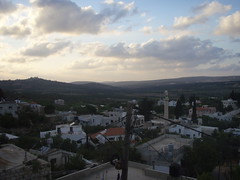
Marda is a beautiful old village during the month of April, looking very lush with many flowers in bloom. The temperature was superb and a nice relief from the heat of the Dead Sea Valley. We arrived in Marda a day before the course was to start, we greeted by a gentlemen named Murad Al Khufash. Murad is the lasting impression made by the Permaculture activities of years gone by. With a family history dating back hundreds of years in Marda, he is the pioneering force behind the continuation of Permaculture in the region.  It was through his initiative and education centre that facilitated our teaching of this course.


Marda
Originally uploaded by
tlbaraka
The next day we participated in a small tour of the site. We discussed the possibilities of Permaculture in the future of villages like Marda. Murad's plans to make a centre are just in the beginning phase. How to sustain such efforts in the face of difficulties created by the occupation is a challenge. Despite all of the turmoil and risk Murad pushes on and much good is coming from his work. He would like to see the local people re-establish a relationship with there land through the positive Permaculture principles. It can take some time to develop a relationship of understanding between Permaculture and the traditional cultural methods. Murad takes it step by step introducing hands on practical techniques that help the community. By hosting this course he has made a big statement to his village.


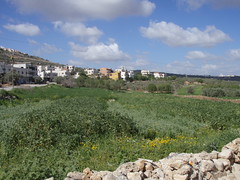
Crops
Originally uploaded by tlbaraka
This picture, which is close to the Permaculture demonstration site, is an example of traditional Palestinian farming practices and village organization. The crops that are seen in the foreground are broad beans,and chick peas and in the distance to the left is wheat. On the slopes behind the village off the the left are very old olive terraces. This village is lucky enough to have two sources of flowing spring water. Unfortunately both springs are not being used to their full potential and are presently contaminated with wastes and garbage.


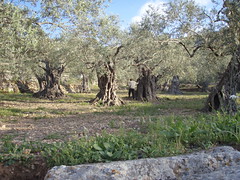
Old olive grove in Marda
Originally uploaded by tlbaraka


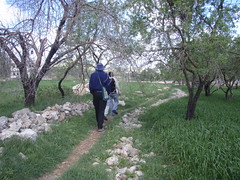
Tour of Site
Originally uploaded by tlbaraka
In the valley below the village the land is divided up by families owning small terrace fields. The soil appears to be a chocolate colour clay-loam with numerous pieces of limestone. The stone is moved out of the fields and used for the terraces that mark parcel boundaries.

The traditional agricultural system appears to be one of rotational tillage production, though many practitioners are using arogcheimicals. There are productive trees of olive, almonds, apples and stone fruits on the edges. All of the basics are there. This system of agriculture is ripe for redesign. It would not be much work design some hard wear to access the springs, some earth works for better water soakage; and diversifying the edge forest system to increase fertility, products, reduce the amount of area in tillage, and increase the amount of permanent pasture. These lands have been under intensive cultivation for many thousands of years. It is only by virtue of the rich subsoil and abundant water that they have held up for so long. Soil organic matter is marginal at best. From a design stand point Marda is on pretty good footing with tree production on the upper slopes, housing in the mid-slopes and broad scale cropping on the flatter lands below. With near 600mm of rain per year and two perennial springs there is more than enough water to go around.

The course went off well with good attendance and the local community well represented by young people employed in various agricultural activities. Unfortunately the practical component of the course was not well developed, due to a lack of prep time on our part. It was a big enough job as it was to work out lecture material for each day.  


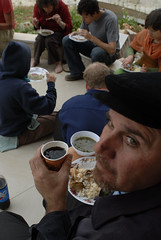
Sharing a meal
Originally uploaded by Jesse and Tanya
Within the context of a military occupation, from check points to a mid-day curfew, this Permaculture experience is one that we will never forget nor fully understand. It will be given its rightful place amongst our collection of stories. We are grateful too Murad for providing this opportunity and keeping us safe. Thank you for sharing with us!!!

Through the positive outlook of Permaculture we were able to share ideas and dreams of the future. The enthusiasim of the local students made the course that much richer. It is gives us strength to connect with others of our generation actively working to make a difference in their communities. This is a thread of consistency we have seen everywhere we have been. We are blown away by the overwhelming co-operative and  positive action going on even in the face of so much difficulty.

If you would like to read more about this event please check out an article written by Tami Brunk.